








A six-axis arm is not one cable run. The cable that leaves the base, the one along the upper arm, and the one that passes the wrist see different motion, carry different circuits, and fit through different openings. A request that gives one line for the whole arm forces the supplier to guess, and the guess is wrong somewhere: the base run inherits the wrist's diameter limit, or the wrist run inherits the base's core count. This guide is for the engineer or buyer at a robot builder who writes that request. It covers six decisions, taken axis by axis in the order you can make them, and ends with a run-by-run table you can paste into the quote.
The product behind it is Lianbang's robot cable, a torsion-resistant, high-flex cable in power, encoder, and hybrid builds for six-axis and cobot joints, supplied as bulk cable for the builder to terminate. The method applies to any six axis robot cable request.
What is a 6 axis robot, joint by joint
A six-axis robot is an arm with six rotating joints in a chain, each one moving everything beyond it. Numbered from the floor up, the usual layout is:
| Axis | Joint | What it does |
|---|---|---|
| 1 | Base | Turns the whole arm around a vertical axis |
| 2 | Shoulder | Swings the lower arm forward and back |
| 3 | Elbow | Raises and lowers the upper arm |
| 4 | Forearm roll | Rotates the forearm around its own length |
| 5 | Wrist bend | Tilts the wrist up and down |
| 6 | Flange | Spins the tool around its own axis |
Every axis has its own motor, and each motor usually needs power, encoder feedback, and often a brake. Those circuits travel from the base outward. That chain is what the cable has to follow, and it is why the arm should be written as several runs, not one.
Decision 1: Split the arm into runs at the points that do not move.
Industrial robot wiring is rarely one cable from base to flange. The run breaks wherever your design puts a fixed point: a terminal block in the base, a connector in the upper-arm housing, a clamp before the wrist. Each stretch between two fixed points is one run, and each run is one line on the request.
Mark those points on the drawing first. Every later decision is made per run, so a run that is not named cannot be specified.
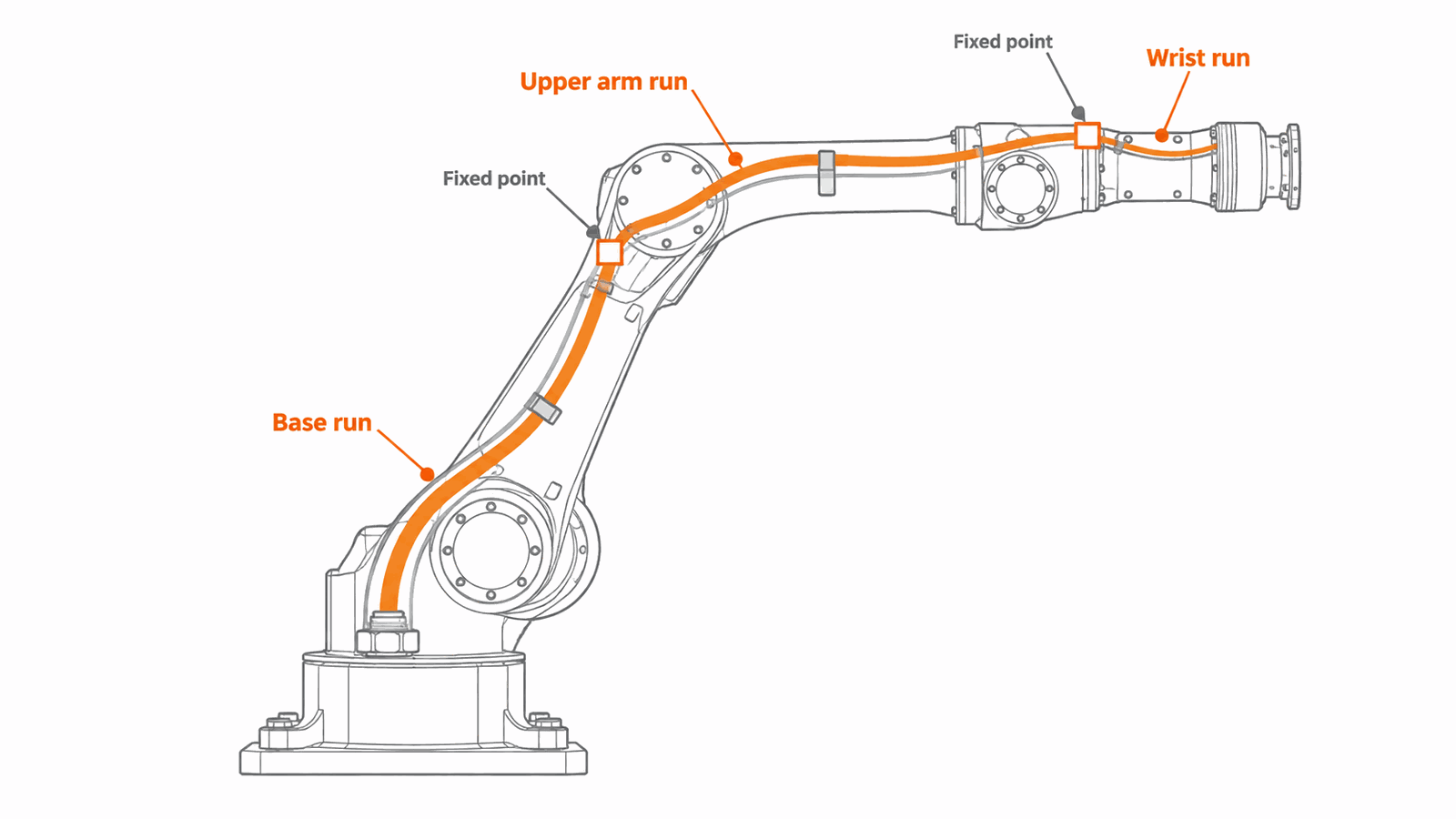
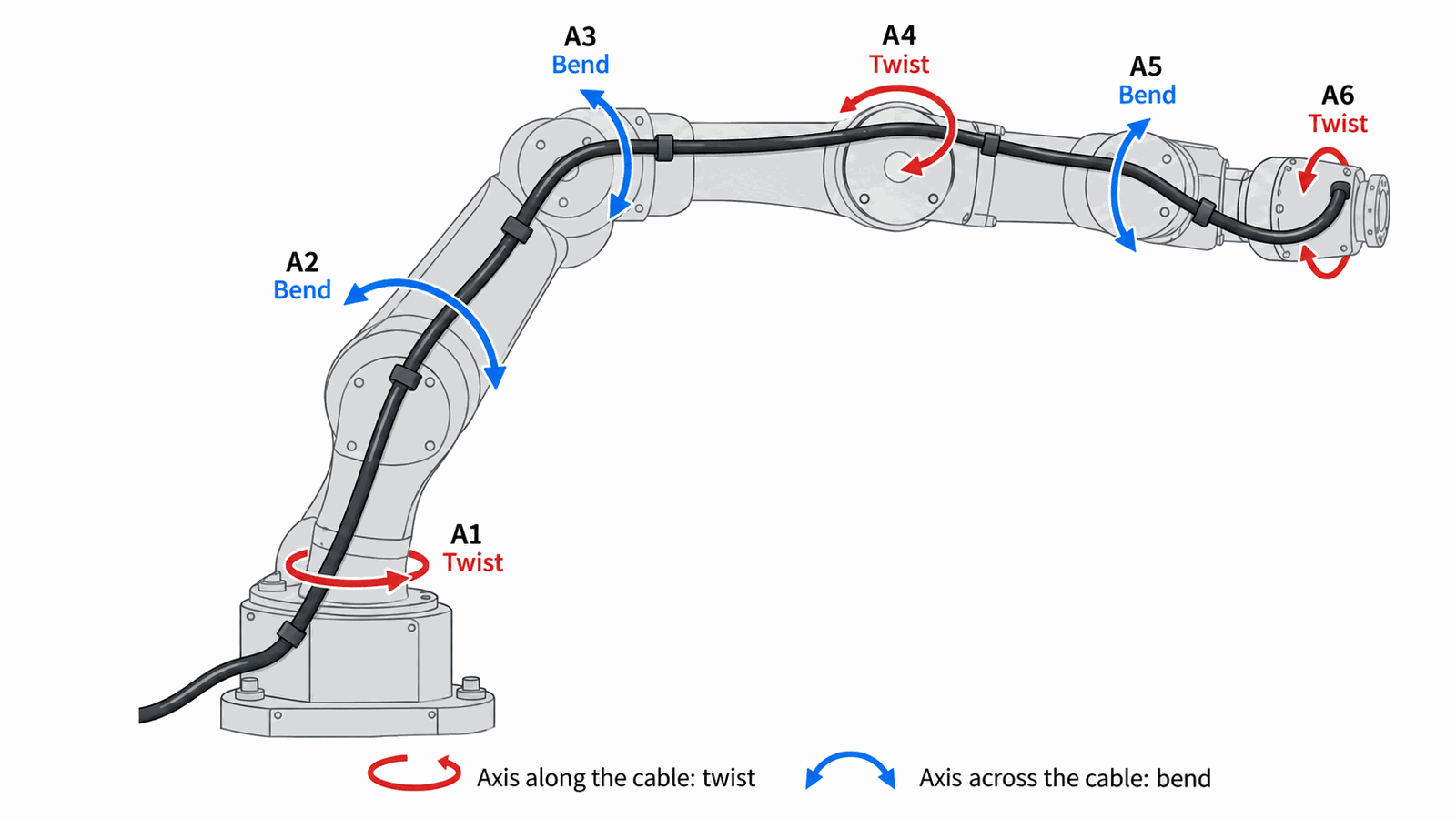
Decision 2: Read each joint's axis. Along the cable it twists; across the cable it bends.
This is the rule that sorts the arm. When a joint's axis of rotation runs along the cable, the cable twists around its own length. When the axis runs across the cable, the cable bends. On a typical arm, axes 1, 4, and 6 twist the cable that passes them, and axes 2, 3, and 5 bend it. Check it against your own routing, because a cable that passes a joint off-center sees some of both.
Torsion vs bending cable is not a question of how flexible the cable is. They are two kinds of stress, and a run that passes a twisting joint has to be rated for twist. Write the motion on each run: which axes it passes, twist, bend, or both, and the rotation range of each twisting axis. The robot wrist cable usually passes two twisting axes in a short length, which makes it the hardest run on the arm.
On the Lianbang robot cable, the torsion angle and flex life are confirmed on the order, against the motion you write for each run.
Decision 3: List what each run carries. The base run carries the most.
A cable run carries the circuits for every motor and tool beyond it. The run out of the base can carry power, feedback, and brake lines for most of the arm. The run past the wrist may carry only the last one or two motors and the tool signals. Exactly which motors sit where depends on the arm, so list the circuits per run from your own layout instead of copying one list down the arm.
Then decide the build per run. Power and encoder can travel as two cables or as one hybrid cable carrying both. A hybrid saves space where many circuits share a tight path. Whether a given hybrid puts power and encoder in the same jacket is confirmed on the order. Lianbang makes power, encoder, and hybrid builds in one series with the same torsion-resistant construction, so different runs on one arm can use different builds.
Decision 4: Size cores and diameter per run. The tightest opening sets the limit.
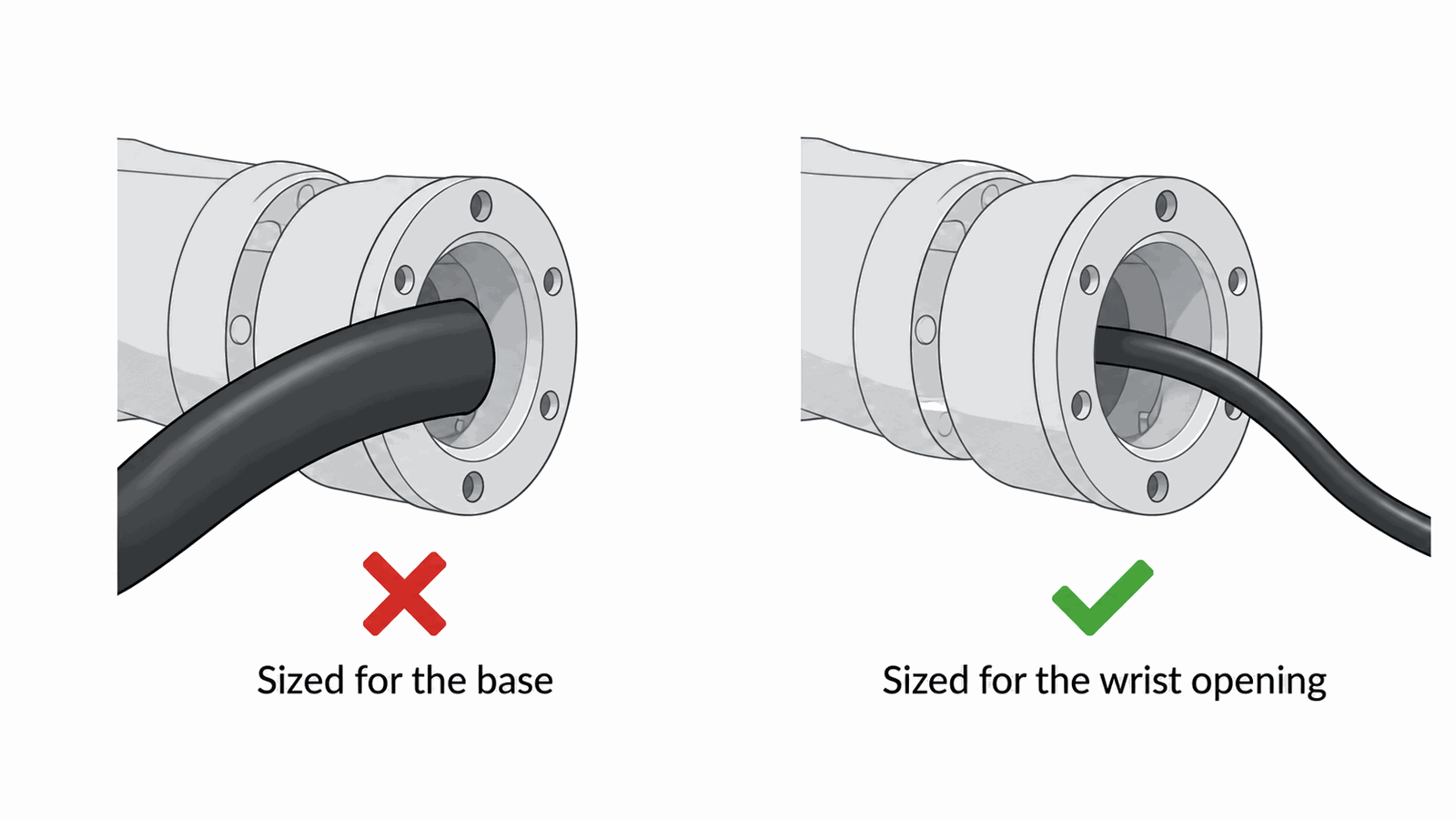
The core count comes from Decision 3, circuit by circuit, plus any spares you want. The outer diameter comes from the path. Each run has a narrowest point: a hollow joint, a clamp, a channel in the casting. The cable has to pass it with room left to twist. That point is usually near the wrist, and it is the reason one cable size for the whole arm fails. A robot arm cable sized for the base run will not pass the wrist, and one sized for the wrist cannot carry the base run's circuits.
Give two numbers per run: the core count with spares, and the largest outer diameter the narrowest point allows. Give the current each power core carries, and the wire gauge is set from that. The Lianbang build is fine-stranded, with a separator between the cores to limit internal wear. Core count and outer diameter are made to order. Wire gauge is confirmed on the order.
Decision 5: Set shielding, jacket, and color per run. Conditions change along the arm.
Shielding follows the circuits. A run carrying encoder feedback next to motor power usually needs it on the feedback side. A run with power only may not. A shield adds diameter, so it has to fit inside the limit from Decision 4. If the robot or the cell has an EMC requirement, attach it.
The jacket follows the place. The base sits near the floor and the cabinet. The wrist sits next to the tool and meets what the tool throws off: weld spatter, coolant, cleaning agents, or abrasion against the arm. Write what each run meets, and the jacket compound is chosen against that list. Then give each run its own jacket color, so the line and the service technician can tell the runs apart at a glance.
Shielding and jacket compound are confirmed on the order. Jacket color is made to order, with black as the standard.
Decision 6: Measure each run at its own extreme pose, with slack at every twisting axis.
Each run reaches its longest path at a different pose. The base run stretches when axis 1 sits at the end of its rotation. The wrist run stretches when the forearm and flange are both turned to their limits. Measure each run with the arm in the pose that stretches that run most, and add slack at every twisting axis it passes so the twist spreads over a length instead of piling up at the clamp.
Write the routed length per run, and the tightest bend on that run. The minimum bend radius depends on the build and is confirmed on the order. Length is made to order. The run from the base to the cabinet, outside the arm, is a separate run with its own motion, and often a different cable.
Five mistakes when one line covers the whole arm
- Writing one cable line for six axes, so the supplier picks one diameter and one core count that suit no run.
- Writing "high flex" on every run instead of naming which runs pass a twisting axis.
- Copying the base run's circuit list to the wrist, so the wrist cable is too thick for its opening.
- Measuring every run at the same pose, so one of them is short at the far end of travel.
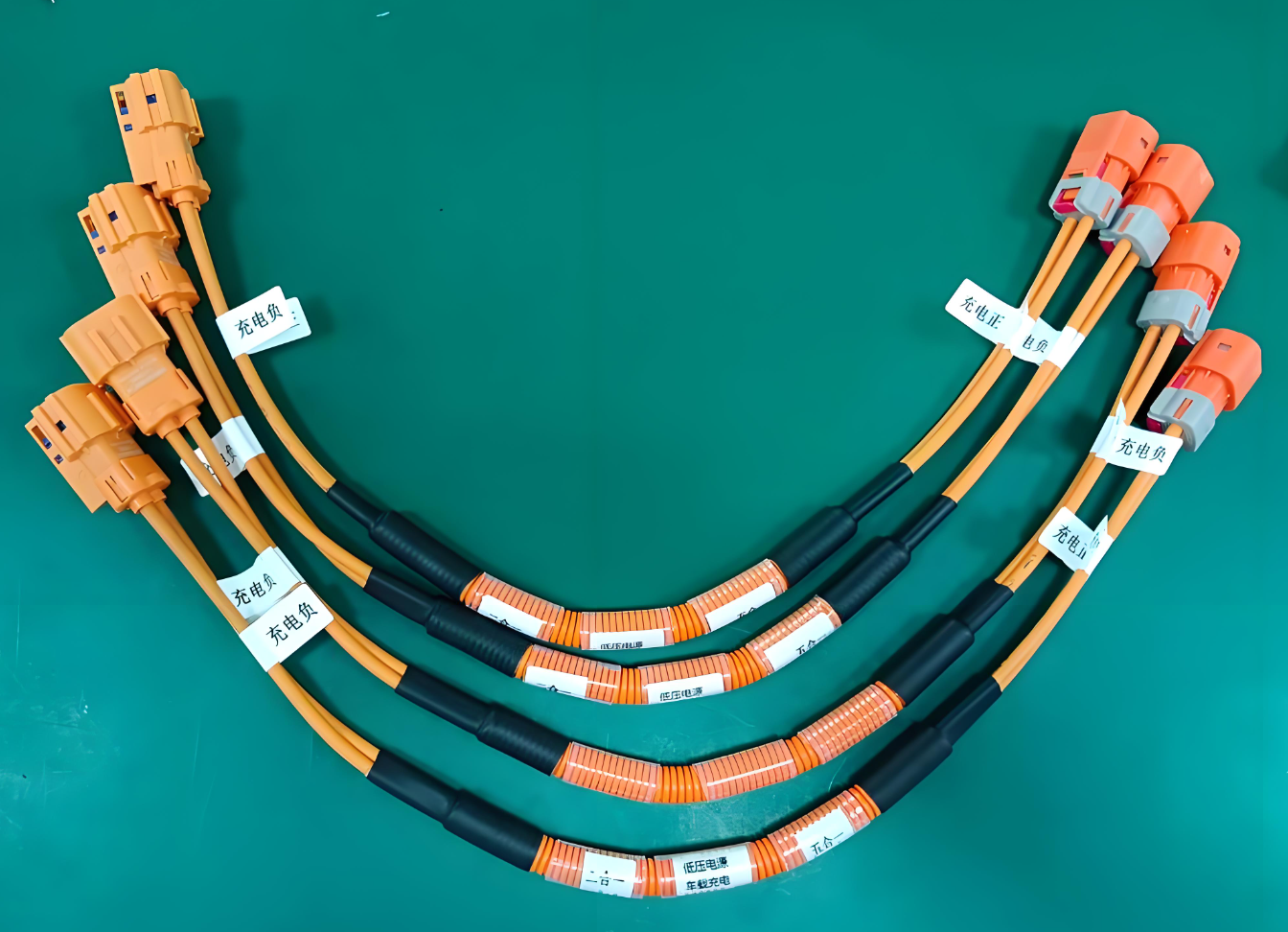
- Ordering the wrong product. This series is bulk robot cable for the builder to terminate. It is not a harness with connectors and not a dress pack, and a harness is a separate quote. The rating is -25 to +80°C, with RoHS and REACH.
What to send for a quote
Paste this table into the request and fill one row per run.
| Run | From – to (fixed points) | Axes passed | Twist, bend, or both | Circuits | Cores incl. spares | Current per power core | Max outer diameter | Shielded circuits | Jacket meets | Color | Routed length |
|---|---|---|---|---|---|---|---|---|---|---|---|
| Base | |||||||||||
| Upper arm | |||||||||||
| Wrist |
Add below the table:
- Robot type and model
- Rotation range of each twisting axis
- Tightest bend on each run
- Any EMC requirement
- Torsion and flex-life targets, with the test method, if you have them
- Quantity per robot and per year
On the robot cable, length, core count, outer diameter, and jacket color are made to order for each run. Torsion angle, flex life, shielding, jacket compound, wire gauge, and the hybrid layout are confirmed on the order, run by run. Send one row per run, and the quote comes back the same way, so each run can be checked against the arm it goes into.