








The board is already placed when the short run inside the housing gets ordered. A control board, an instrument, or a small appliance still needs a handful of low-voltage lines out to a button panel, a sensor, or an LED. How to order custom ribbon is the six decisions below, in the order a buyer should make them, and a list you can paste into the request.
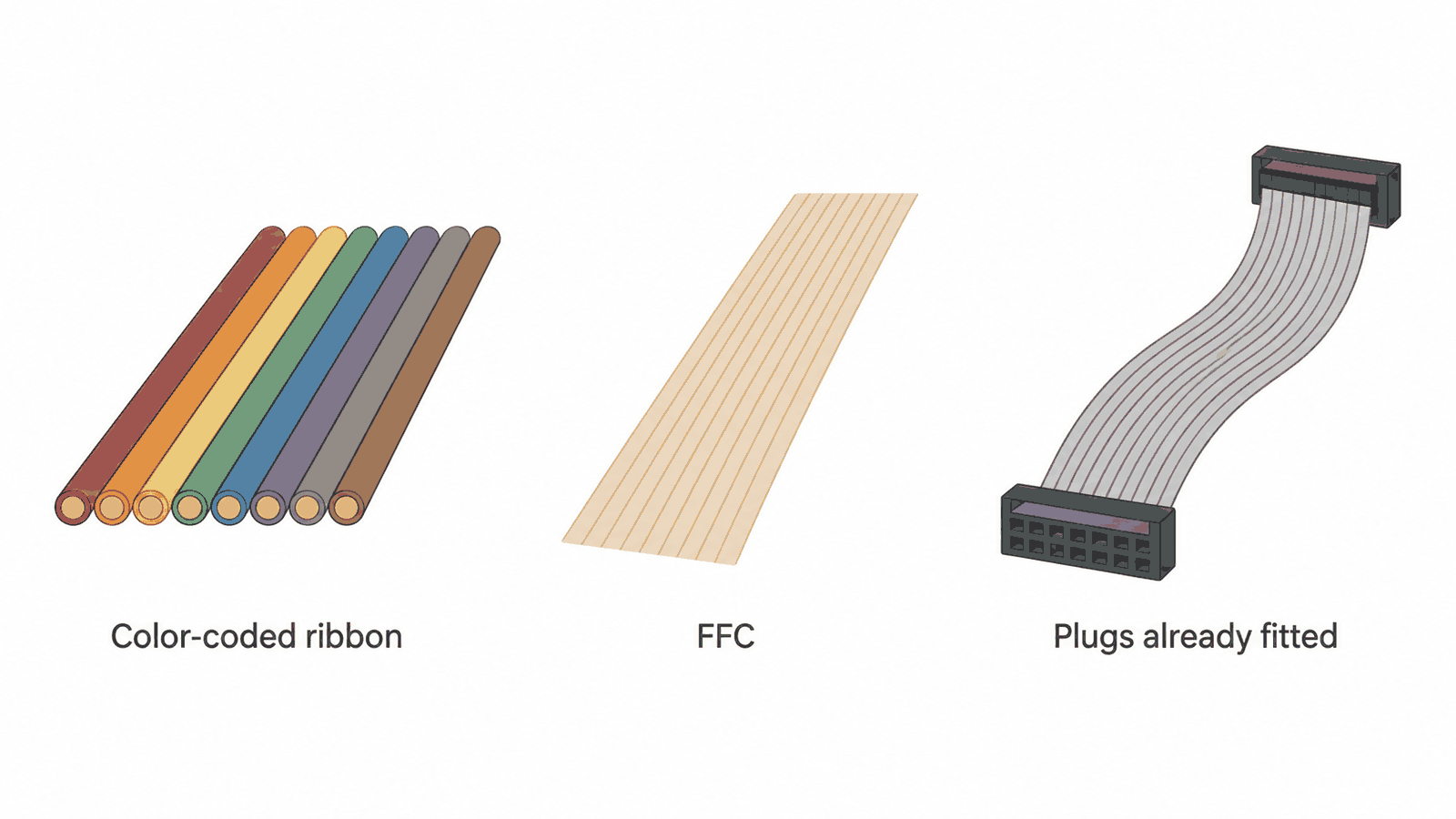
What is a ribbon cable, on a parts page, comes back as three different products. This page is only one of them: eight insulated conductors laid flat, each in its own color.
The product behind it is Lianbang's color-coded ribbon cable, eight conductors, eight insulation colors, for low-voltage control and small-current power. PVC insulation, PE to order, rated -20 to +80°C. It is sold as bulk wire, by the meter or on spools, for the assembler to crimp or solder. The rules apply to any color-coded flat ribbon bought for that point-to-point run.
Decision 1: Name the wire. An FFC, a gray ribbon, and a finished harness are other orders.
What is a ribbon cable used for gets answered with plugs as often as with wire. Ribbon cable vs ffc is the first split. An FFC is a flat flexible circuit, a different construction. This card is eight insulated conductors laid side by side.
Gray vs rainbow ribbon is the second split. A gray ribbon is one color, and the first position is read off a stripe. This card is eight insulation colors, one per conductor. An all-gray cable is not this product.
Ribbon cable vs wire harness is the third split. The harness is the finished item, plugs included. This page is the bulk wire. If the quote you need already has plugs on it, that item is a separate quote.
Decision 2: Use it for low-voltage control. Leave high-speed differential off this order.
When not to use ribbon cable is when the run is a high-speed differential pair. This card does not carry that signal. Those pairs belong on a different cable and a different quote.
Ribbon cable current is the other limit. The card says small-current power, and signal lines and power lines can share the same ribbon. It does not publish an amp figure. The current is confirmed on the order. The voltage rating is blank on the card too, so that number is confirmed on the order. Do not copy it from another catalog.
Decision 3: Write eight conductors, and write the color order.
How many conductors ribbon listings offer runs from a few cores to several dozen. This card is 8. Write 8 on the request. Do not leave the line as "a ribbon" and let the supplier pick a count.
Ribbon cable color code is how the assembler reads polarity. Eight fixed colors mean each wire is identified at a glance, on the line and again when a technician opens the unit years later. Low voltage wiring color, on this order, is that set of eight, one per conductor.
Rainbow ribbon color order is the sequence buyers expect. The card offers a standard sequence, or a custom sequence when the board drawing already assigns colors. Write the order if the drawing fixes it. Do not assume the supplier's standard matches the drawing.

Decision 4: Choose the flat lay, then leave pitch and gauge for the order.
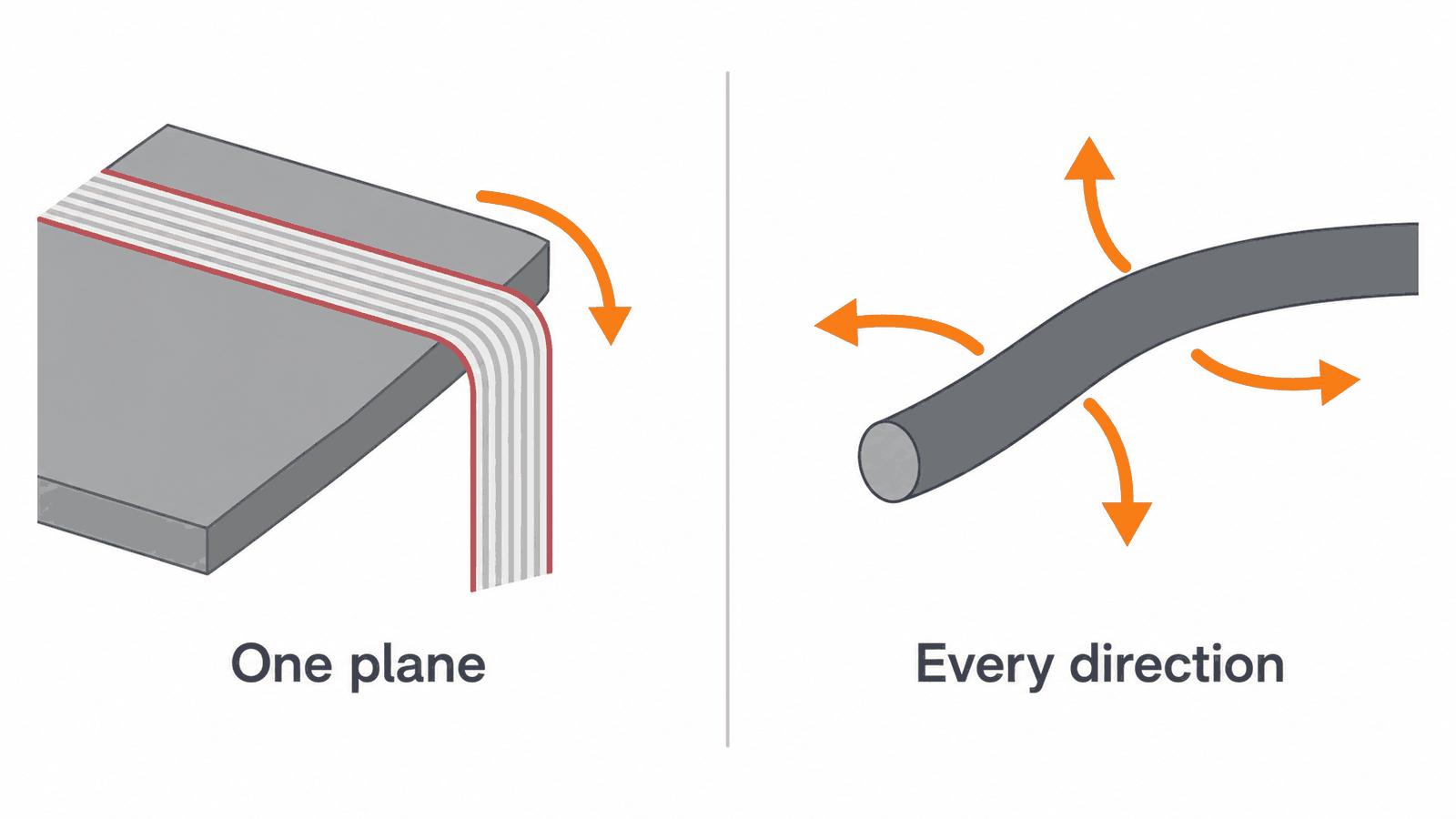
Flat cable vs round cable is a routing choice. A flat ribbon stays tidy and bends on one plane around a board edge. A round cable is the better form when the run has to flex in every direction. This card is the flat lay, for the run inside the housing.
Ribbon cable pitch explained is the center-to-center distance of the conductors. The card does not publish a pitch, and it does not publish a width. A pitch taken from another catalog is confirmed on the order, against the board the wire lands on.
28 awg vs 26 awg ribbon is a gauge argument other buyers have. This card does not publish a gauge. The gauge is confirmed on the order. Do not fill a number because a search suggested it.
Decision 5: Insulation and temperature. PVC is on the card. PE is to order.
Pvc vs pe insulation is a material choice. PVC is the insulation on this card. PE is to order. Write PE only if the build needs it.
Ribbon cable temperature rating on this card is -20 to +80°C. A hotter housing, or a colder one, is outside this rating. Check the range against the housing before you copy the cable onto that design.
Decision 6: Crimp or solder the wire. Plugs already fitted are another quote.
Idc vs solder termination splits a press-on plug from the wire itself. The press-on method belongs to the finished item. This card is the wire, and the conductors take either crimp or solder. How to crimp ribbon cable is the assembler's process, with the assembler's contacts. We sell the wire.
The cable is unshielded. A shield is not on the card, so a shielded build is a different product. An outer jacket is optional and made to order. A clear jacket on a sample is not the standard until the order asks for it. Length is made to order. Supply is bulk, by the meter or on spools. The card does not publish a cut length.
Five mistakes that put the wrong ribbon on the board
- Pricing an FFC, a gray ribbon, or a cable that already has plugs, against eight color-coded conductors.
- Putting a high-speed differential pair on this ribbon. It is low-voltage control and small-current power only.
- Leaving the conductor count blank, or copying a color order that does not match the board drawing.
- Filling a pitch or a gauge the card does not list.
- Ordering the wrong product. This series is a flat ribbon, eight conductors, eight insulation colors, PVC with PE to order, rated -20 to +80°C, unshielded, supplied by the meter or on spools for the assembler to crimp or solder. A cable with plugs already fitted is a separate quote.
What to send for a quote
Paste this into the request.
- That the cable is color-coded flat wire, not an FFC, and not a cable with plugs already fitted
- Where it runs: control board, instrument, lab equipment, small appliance, test fixture, or a low-voltage medical device
- That the lines are low-voltage control, small-current power, or both on the same ribbon
- Conductor count, if it is not the eight on this card
- The color sequence, if the drawing fixes it
- Pitch, if the board already sets it
- Wire gauge, if it is already sized
- PVC, or PE if the build needs PE
- The housing temperature, if it might sit outside -20 to +80°C
- Whether the assembler will crimp or solder
- Length
- Outer jacket, or no jacket
- By the meter, or on spools
Length, color sequence, wire gauge, pitch, and an outer jacket are made to order on the color-coded ribbon cable. Voltage, current, and any pitch the card leaves blank are confirmed on the order. Send the list above and the quote comes back against the run inside your housing.