








A switch-link quote often arrives as one line: 800G, three meters. That line does not say whether the run stays in one rack or crosses to the next one, and it does not name the module at each end. QSFP cable types on a finished-cable order are the jumper between two cages, not the wire inside a module. If you are the engineer or buyer writing that line, work through the six decisions below, check the five mistakes that ship the wrong build, and paste the checklist at the end into your request.
Lianbang's 800G QSFP-DD ACC is the finished cable this guide starts from. It has a module shell at each end, eight channels, a 76-pin connector, and a zinc-alloy shell. The page lists it for a short link inside a data center rack.
What is a QSFP cable, on this order
What is a QSFP cable, for a switch order, is the finished jumper that plugs into a cage at each end. The wire inside a module shell is a different product and a different quote. Lianbang's 800G page says so: the differential cable already on the site is the wire inside a module. This one is the finished cable.
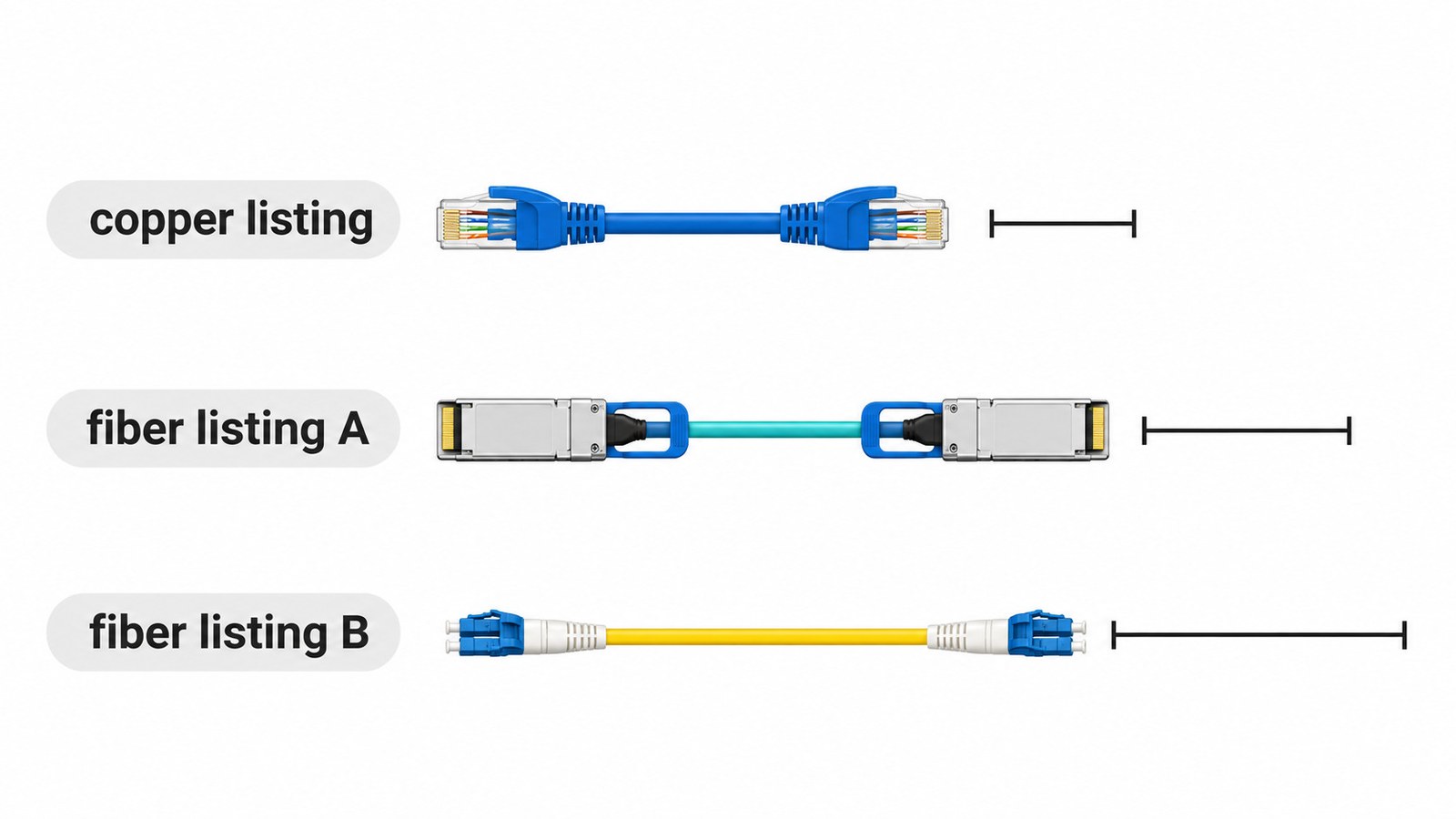
QSFP cable types on these three pages split by medium and by module. The 800G page is the short copper listing. The 400G QSFP-DD page and the 100G QSFP28 page are active optical cables over multimode fiber.
Decision 1: DAC cable vs fiber starts with where the run sits.
DAC cable vs fiber, on these pages, is a length question before it is a name question. The 800G page lists a short high-speed link inside one rack, and it calls that copper run the lower-cost, lower-power alternative to a short fiber run. The 400G page lists the longer run, between racks or across a room, where the link is fiber rather than copper. The 100G page lists storage, data, and high-performance computing links, and its medium line is 4-pair multimode fiber.
Write the path in one sentence: both ports in the same rack, or a run that leaves the rack. A same-rack port pair is the 800G listing. A run that leaves the rack is one of the two fiber listings, and the module in Decision 3 decides which.
The 100G photo on the page is a black round cable with a module and a blue pull tab at each end. The page still names the medium as 4-pair multimode fiber. Order from that medium line. The jacket color in the photo does not turn the cable into copper.

Decision 2: Keep the ACC title and the DAC wording on the same line.
The flyer and the catalog title on the 800G page say ACC. The catalog body says QSFP-DD DAC, and it also says active transmission up to 5 m. The page keeps the title as ACC and keeps the numbers from the body. An order that asks for "the DAC" and "the ACC" as two parts is asking this one page to be two products.
Write ACC on the line, and add that the body also says QSFP-DD DAC, active, up to 5 m. That is one cable. A passive copper jumper with no active reach is not what this page prints.
Decision 3: Match the module at both ends.
The 800G cable and the 400G cable both end in QSFP-DD. The 800G connector is 76-pin, in a zinc-alloy shell. The 400G connector is a hot-swappable QSFP-DD to CMIS. The 100G port is QSFP28, to SFF-8665 and IEEE 802.3bm.
A QSFP28 cage and a QSFP-DD cage do not take the same plug. Write the module at the near port and at the far port. These three photos each show a module at both ends of one cable. A split from one cage into several smaller cages is not the photo on these pages. If the drawing needs that split, the build is confirmed on the order.

Decision 4: Copy the reach from the page that matches the cable.
Each page prints its own reach. The 800G page prints one: active, up to 5 m. Jacket options on that page are PVC or low-smoke halogen-free.
The 400G page prints the reach twice, and the two lines do not match. The description says 100 meters. The feature list says 70 meters on OM3 or 100 meters on OM4. Per-channel rate is also printed twice: up to 50 Gb/s in the description, and up to 53 Gbps, as 8 x 53 Gbps PAM4, in the feature list, with CDR on the transmit and receive channels. Keep both lines. Do not collapse them into one number on the order.
The 100G page prints the reach twice as well. The description says 70 meters on OM3. The feature list says up to 100 meters on OM4. Both stay on the line.
Measure port to port, including the drop down the rack. Then pick the page. A measured run inside 5 m can sit on the 800G active listing. A run past 5 m is outside that listing. On a fiber page, name the fiber grade the page uses, OM3 or OM4, because the meters change with it. Copying 5 m onto an AOC line uses the copper page's number.
Decision 5: Keep the rate and the channel count on that same line.
The 800G page lists 800 Gbps PAM4, eight channels at 112 Gbps. The same description also says up to 56 Gb/s NRZ or 112 Gb/s PAM4, for an aggregate up to 800 Gb/s. Both sentences stay. Standards on that page are QSFP-DD MSA and Ethernet. EMI and RoHS are listed.
The 400G page lists an aggregate 400 Gb/s, eight transmit channels and eight receive channels. Power is 3.3 V and under 10 W per end. Operating temperature is 0°C to 70°C, with digital diagnostics. Standards listed are SFF-8436, SFF-8432, SFF-8472, and IEEE 802.3bm. RoHS is listed.
The 100G page lists an aggregate 100 Gb/s, four transmit and four receive channels at 25 Gb/s each. Management is I2C to SFF-8636. Receive amplitude and pre-emphasis are programmable, the transmit equalizer is programmable, and retiming is optional. Maximum power is 2.5 W per end. RoHS is listed.
Leave each of those on its own line. A 112 Gbps channel count does not belong on the 100G line, and a 25 Gb/s channel count does not belong on the 800G line.
Five mistakes that ship the wrong switch cable
- Writing "800G, 3 m" and leaving the medium blank. The 800G page is the in-rack active listing. The 400G and 100G pages are fiber.
- Ordering an ACC and a DAC as two parts. On the 800G page the title says ACC and the body says QSFP-DD DAC. That is one listing.
- Copying the 5 m active reach onto an AOC line. Each fiber page prints its own meters, and the 400G and 100G pages each print two figures.
- Plugging a QSFP28 end toward a QSFP-DD cage. The 100G page is QSFP28. The 800G and 400G pages are QSFP-DD.
- Reading the 100G photo as copper. The page names 4-pair multimode fiber. The photo is a black round cable.
What to send for a quote
- Path: both ports in one rack, or a run that leaves the rack.
- Cable: 800G QSFP-DD ACC (body also says QSFP-DD DAC, active, up to 5 m), 400G QSFP-DD AOC, or 100G QSFP28 AOC.
- Module at each end: QSFP-DD or QSFP28. Same module both ends, unless a drawing says otherwise and the build is confirmed on the order.
- Measured length, port to port, including the drop down the rack.
- Reach line you are using: 5 m active on the 800G page; on the 400G page both the 100 m description and the 70 m OM3 / 100 m OM4 feature list; on the 100G page both 70 m OM3 and up to 100 m OM4.
- Rate and channels, copied from that same page, including both per-channel lines on the 400G page.
- 800G jacket: PVC or low-smoke halogen-free. 400G power, temperature, and CDR. 100G power and whether retiming is required.
- The two part numbers you are replacing, if this cable replaces one already in the rack.
Send that list through the quote button on Lianbang's 800G QSFP-DD ACC page. A 400G or 100G fiber run is a separate line on the same request.