





A robot cell usually has three different motions, and a request that says "high flex cable" treats them as one part. The cable in the drag chain travels back and forth. The cable at the wrist twists in place. The cable on a servo motor mostly has to keep noise off the drive. This guide is for the engineer or buyer who writes that request. It separates the three families, then walks through six decisions and a list you can paste into the quote.
Lianbang's robot cable is the robotic family: a black round cable, sold by the meter, for the builder to terminate. The drag-chain family is the continuous flex cable. The rules apply to any of these cables, not only ours.
What is robot cable, and where a robot cable vs drag chain cable choice starts
What is robot cable, in this range, is a lightweight shielded cable built for robot motion, with a 15D bend radius, a VW-1 flame rating, and the standards 2PFG 2577 and CRIA 0003-1-2016 named for that family.
A drag chain cable vs flexible cable vs robot cable comparison is a torsion vs bending cable comparison. "Flexible" only says the cable can move. It does not say how.
| Family | The motion it is built for | Bend radius | Flame rating | What else is named |
|---|---|---|---|---|
| Drag-chain and flexible | Back and forth. Bend, oil, and abrasion resistance, water-resistant construction | 10D | FT2 | Series TRVV, TRVVP, TRVVSP, RVVYP |
| Servo | Servo motors and imaging systems. Flexible routing plus interference protection | 7.5D | VW-1 | Oil-resistant, bend-resistant, double shielding |
| Robotic | Robot motion. Shielded transmission, durability, abrasion resistance | 15D | VW-1 | 2PFG 2577 / CRIA 0003-1-2016 |
D is the cable outside diameter. A 10D rating on a 7 mm cable is a 70 mm bend radius. Write the family and the motion on the request before you write a length.
Decision 1: Name the motion first. The family follows it.
Industrial robot wiring fails in the same way on a lot of quotes: one cable part number for the whole cell. The chain beside the machine and the wrist on the arm are not the same duty.
Use the drag-chain family when the cable reciprocates in a chain. Use the robotic family when a joint twists the cable, which is the usual case on a six-axis arm. Use the servo family when the run feeds a servo motor or an imaging system and the problem to solve is interference, not torsion.
If one cell needs all three, write three lines. A single line that says "robot cable for the cell" gets you one of them.

Decision 2: Read the bend radius as a limit, not as a flexibility score.
The minimum bend radius of a flexible cable is the tightest bend that family is rated for. A smaller multiple is a tighter bend. The servo family, at 7.5D, is allowed to bend tighter than the drag-chain family at 10D. The robotic family, at 15D, is not.
That is the line people fill in backwards. The robotic family is described as lightweight and highly flexible, and a buyer routes it into a tighter bend than the drag-chain cable beside it. Highly flexible describes the construction. 15D describes the limit. The minimum bend radius flexible cable tables quote is this limit, not a score. Check the outside diameter, multiply by the family's rating, and compare that radius with the tightest bend in the routing.

Decision 3: Match the flame rating and the jacket to the station, not to the word flexible.
The drag-chain family is rated FT2. The servo and robotic families are rated VW-1. FT2 is a horizontal flame test and VW-1 is a vertical one, so one rating does not stand in for the other. Write the one the station requires.
The environment splits the same way. The drag-chain family calls out oil, abrasion, and a water-resistant construction. The servo family calls out oil resistance and double shielding. The robotic family calls out abrasion resistance and shielding. If the station has oil, weld spatter, or washdown, write that next to the family. Do not assume every "flex" cable carries all three.
PUR cable meaning, on the published dynamic constructions, is a black polyurethane jacket. PUR cable vs PVC matters when a station was specified around PVC: the three dynamic rows below are PUR, and a different jacket is confirmed on the order rather than swapped in silently.
Decision 4: Pick the conductor mix from the circuit. Do power cables interfere with signal cables in the same jacket?
Do power cables interfere with signal cables when both sit in one jacket? They can. A hybrid cable power and signal construction depends on the shield that build specifies, and on you saying which cores are which.
These are published constructions, not a full catalog. The final mix is confirmed against the application.
| Construction | Outer diameter | Jacket / shield | Application |
|---|---|---|---|
| 28AWG × 2C + 22AWG × 2C | 4.6 ± 0.2 mm | Black PUR | Dynamic / robotic |
| 28AWG × 4C + 22AWG × 2C | 5.2 ± 0.2 mm | Black PUR | Dynamic / robotic |
| 26AWG × 10C + 22AWG × 2C | 7.0 mm | Black PUR | Dynamic / robotic |
| 18AWG × 4C + F + AB (85%) | 8.7 mm | Shielded | Servo / motor |
The first three put two conductor sizes in one black PUR jacket. Write which size carries power and which carries the other circuit. Copying the row without that split is how two quotes describe different cables.
The PUR constructions also include F + nonwoven wrap + B, as specified. F is foil, B is braid. The servo row is separate: four 18AWG cores, foil, and an 85% braid, for a servo or motor run. It is not one of the three PUR rows.
High flex cable specifications that stop at AWG and a diameter still leave the shield and the core assignment open. Those two belong on the request.
Decision 5: A cycle count is only comparable under the same test.
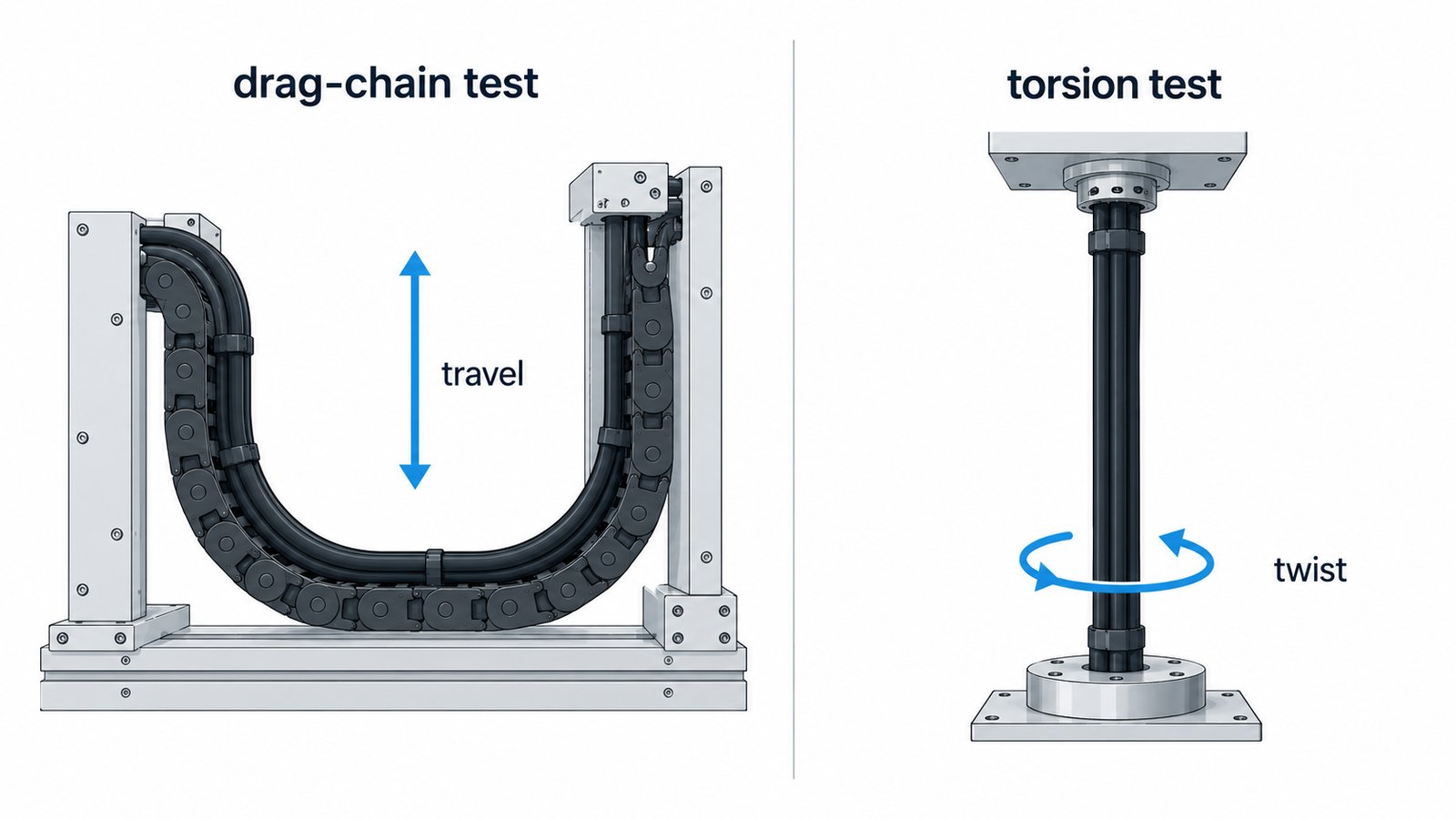
What is torsion test, on this range: a 1 m sample twisted ±180° at 60 cycles per minute. The drag-chain test is a U-shaped bend at R = 10D, 1 m of travel, also at 60 cycles per minute. Under those conditions the three black PUR constructions passed 5 million drag-chain cycles and 500,000 torsion cycles.
Two limits sit on that sentence. The results apply to those three PUR constructions, not to every cable in the three families, and not to the shielded servo row. And a cable flex life testing number from another supplier is a different number unless the radius, the travel or the twist angle, the sample length, and the speed match. A larger count run on a gentler bend is not a longer-lasting cable.
Cable torsion test conditions belong on the quote next to the count: sample length, angle, and cycles per minute. The same for the drag-chain test: shape, radius, travel, and speed.
Decision 6: Bulk cable or a harness. Say which quote you want.
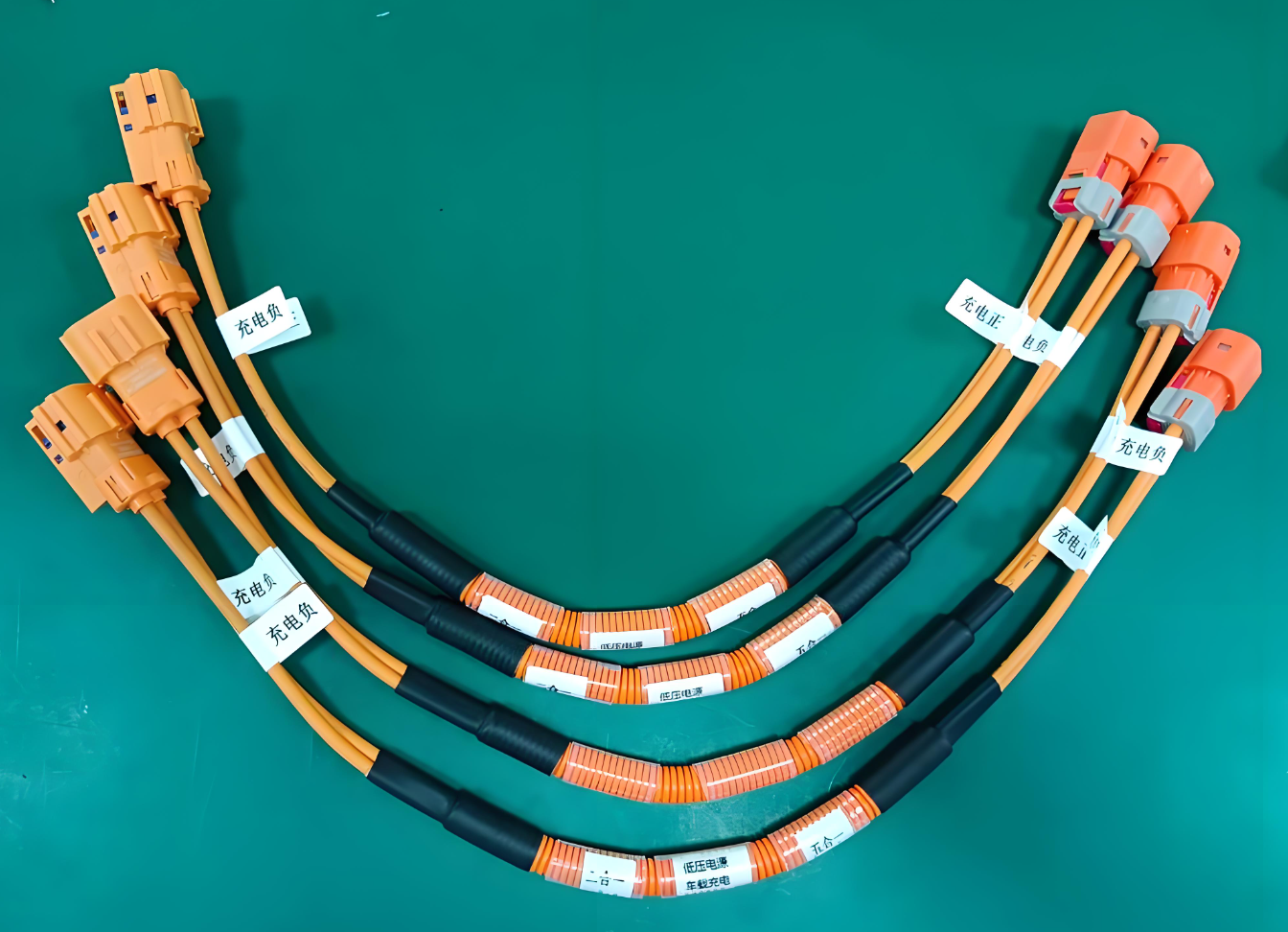
The constructions above are cables. A connectorized harness, with plugs, labels, and a pinout, is a different quote. The robot cable is supplied by the meter for the builder to terminate. If the drawing shows connectors, say so, and send the drawing. If it does not, ask for the cable.
Five mistakes that put the wrong cable on the arm
Why robot cables fail, on the quotes that come back wrong, is a family that does not match the motion. The same five misses show up on drag-chain and servo requests.
- One part number for the cell. The chain, the wrist, and the servo motor are three duties.
- Routing the robotic family into a tighter bend than 15D because the description says highly flexible.
- Treating FT2 and VW-1 as the same flame rating, or assuming every family is oil-resistant and water-resistant.
- Comparing 5 million or 500,000 cycles with another supplier's count when the radius, the angle, or the speed is different.
- Ordering a harness from a construction table, or a spool of cable from a harness drawing. Say which one, and attach the drawing if there is one.
What to send for a quote
Paste this into the request.
- Motion: reciprocating in a chain, twisting at a joint, or a servo / imaging run
- Family: drag-chain, servo, or robotic
- Tightest bend in the routing, and the outside diameter, so the D rating can be checked
- Flame rating the station requires, and the environment: oil, water, abrasion
- Construction, or your own mix: AWG, core count, and which cores carry power
- Shield: foil, braid, or as specified
- Jacket, if it is not the black PUR on the dynamic rows
- Length
- Bulk cable, or a harness with connectors and a drawing
- Which test you need the number from, and that your routing matches that test
Length, core count, outer diameter, and jacket color on the robot cable are made to order. The conductor mix, the shield, and whether a construction suits the routing are confirmed on the order. The same list works for the drag-chain family. Send it, and the quote comes back for the motion you actually have.