








SAS Storage Backplane Cable Guide
A storage chassis is a backplane, a stack of drive modules, and the cable that carries SAS lanes between them. The backplane is designed first. The drive count is fixed by the enclosure. The cable comes last, and it is usually specified from a mechanical drawing by someone who has to make 12 or 24 drives connect inside a height that was never meant for round cable. This guide is for that person. It walks through the six decisions on a SAS backplane cable order, in the order they should be made, and ends with a quote checklist.
First, what is a SAS backplane. It is the board inside the enclosure that the drives plug into, usually a hot-swap backplane, so a drive can be pulled and replaced with the system running. The cable this guide covers is the run from that board to the drive modules inside a storage server, a disk array, or a SAS JBOD enclosure. Among SAS cable types, it is the internal flat ribbon, not the external cable between chassis.
The product behind it is Lianbang's SAS ribbon cable, a flat differential ribbon in 6-pair and 12-pair builds. The rules apply to any flat SAS cable inside a storage enclosure.
Flat cable vs round cable: why a backplane uses a ribbon
Round cable is fine for one link. A backplane is many links at once, and they all leave the board from the same edge and land on drive modules stacked a few centimeters apart. Round cable in that space becomes a bundle that has to be dressed, tied, and pushed out of the airflow.
A flat differential ribbon runs the pairs side by side in one layer. The ribbon lay keeps parallel pairs from crossing into one another, which is what holds ribbon cable crosstalk down when twelve channels share one path. That is also the plain answer to how to reduce crosstalk in copper cables at this scale: fix the geometry so the pairs cannot wander, rather than adding material after the fact. The flat build saves chassis height, and it bends at the backplane exit in a way a bundle will not. That is the whole case for the ribbon: many channels, one layer, a known bend.
Decision 1: Pair count. SAS 6-pair vs 12-pair.
The Lianbang series comes in 6-pair and 12-pair.
| Build | Differential pairs | Signal conductors |
|---|---|---|
| 6-Pair | 6 | 12 |
| 12-Pair | 12 | 24 |
A 12-pair cable carries twice the channels of the 6-pair cable in the same series. Pick the build from the number of differential channels the backplane connector actually brings out to that group of drives, not from the total drive count in the enclosure. A 24-bay enclosure is usually several backplane segments, each with its own cable, so the question is how many channels leave each segment.
Two things not to do:
- Do not pick the 12-pair because it is the larger one and might be safe. Unused pairs still take width and still have to be routed and terminated.
- Do not split one wide ribbon across two groups of drives on your own. Whether a 12-pair can be broken into two 6-pair groups is a build question. Ask it on the quote.
Decision 2: Total length. Measure the routed path.
The length on the order is the path from the backplane connector, along the sheet metal, around the drive cage or the fan wall, to the last module it serves. It is not the straight distance between two connectors on the drawing. Measure it on the chassis or the 3D model, then add enough slack that the assembler is not pulling a flat ribbon tight across an edge.
There is a SAS cable length limit for any in-chassis copper run, and it depends on the rate the backplane runs and on the build. No catalog number answers that question on its own. The routed length and the rate do, together, and the limit is confirmed on the order.
Total length is set to the order. Bring the routed figure.
Decision 3: Segments. A backplane cable is usually several lengths, not one.
This is the decision that separates a backplane ribbon from a point-to-point cable. Drive modules are stacked, so the cable often has to break out to more than one landing point along its run. Each landing point defines a segment: the length of ribbon between one termination point and the next.
Before you ask for a quote, draw the run and mark every landing point with a distance from the backplane end. That gives you the segment lengths. Segment length is set to the order on the Lianbang build, together with total length. Whether a run can have as many segments as your drawing shows is confirmed on the order, so send the drawing rather than a description.
Getting segments wrong is the most common reason a backplane cable is rejected at assembly. The total length was right; one breakout landed a bay too early.
Decision 4: Exit direction and bend radius. Match the bend to the backplane.
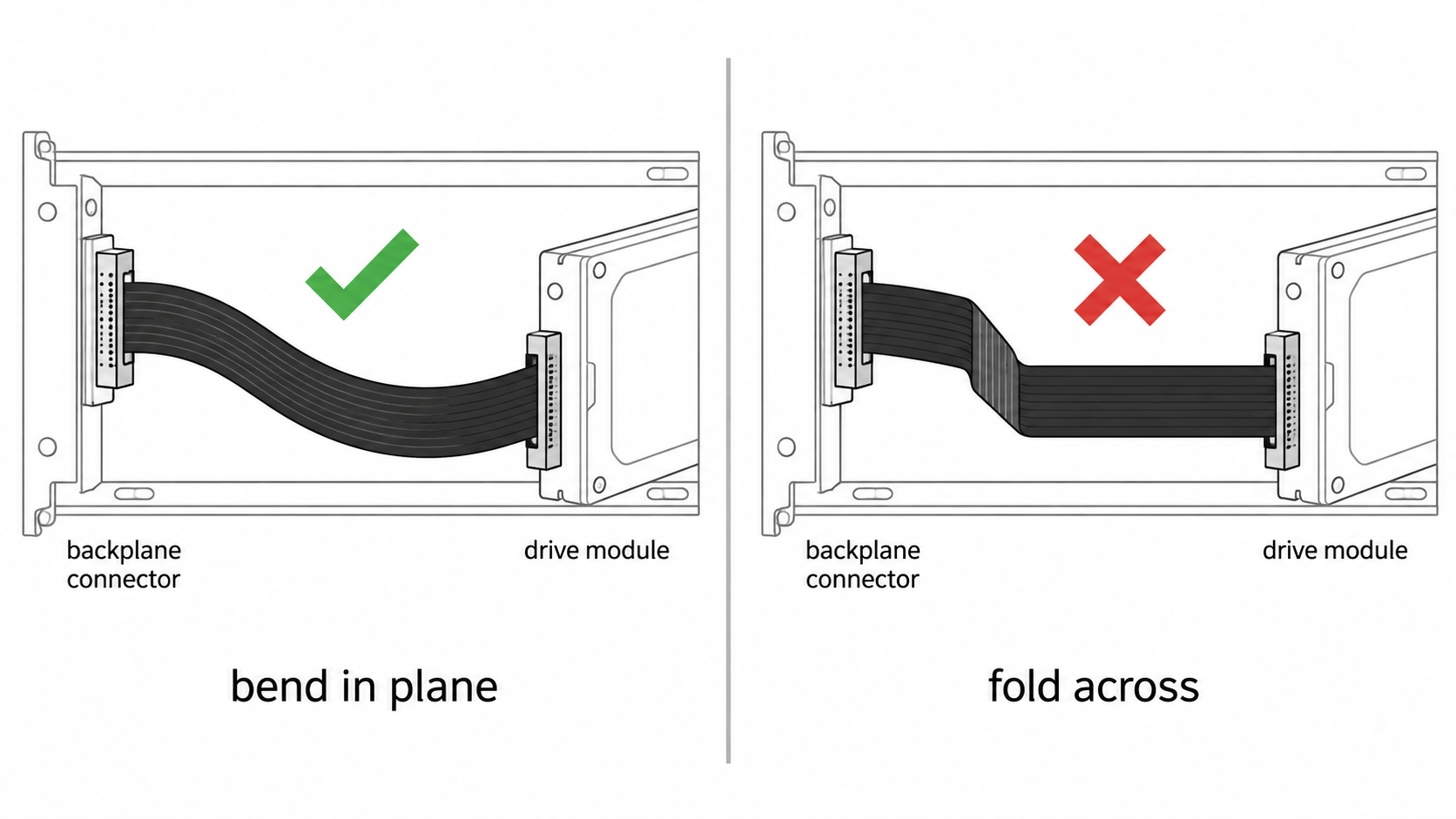
A flat ribbon bends well in one plane and badly in the other. The direction it leaves the backplane connector decides whether the first bend is an easy one or a fold. On the Lianbang build, exit direction is matched to the backplane layout on the order.
Ribbon cable bend radius is the other half of this decision. Every bend in the route has a radius, and the tightest one is what the build has to survive. The minimum bend radius for the build is confirmed on the order, so mark the tightest bend on the drawing instead of assuming the ribbon will take whatever the chassis gives it.
Look at three points on the drawing:
- How the ribbon leaves the backplane connector, and which way the drive modules sit relative to that.
- Where the ribbon has to turn to follow the chassis wall.
- How it enters each drive module, and whether that entry is in the same plane as the exit.
If the exit and the entries are in different planes, say so on the quote. The bend is planned into the build, not left for the assembler to make on the line.
Decision 5: Insulation color. Decide it before assembly, not after.
Insulation color is set to the order. It sounds cosmetic. It is not, in a chassis with several ribbons of the same width leaving one backplane. Color is how the line tells segment A from segment B, and how a field technician tells which ribbon feeds which bay. Pick a color per cable position and put it on the drawing.
Decision 6: Ribbon cable impedance and data rate. These are set on the order.
Ribbon cable impedance is a differential value here, and it is held to the SAS requirement. The value and tolerance are confirmed on the order, because your backplane's target is the reference, and the number is not printed in the catalog. Data rate is also set on the order.
Do not assume a rate from the name. Bring the SAS rate your backplane runs, and if you have a target impedance and a crosstalk budget from the backplane team, put them on the request.
Five mistakes that stall a chassis build
- Ordering by total drive count instead of by the channels each backplane segment feeds.
- Measuring connector-to-connector on the drawing instead of the routed path along the sheet metal.
- Sending a total length with no segment lengths, and getting a cable with one breakout a bay too early.
- Leaving exit direction to the assembler, so the first bend is a fold across the ribbon.
- Ordering the wrong thing. This series is a flat differential ribbon for the backplane-to-drive path inside the enclosure. It is not an external SAS cable and not a round cable. The ribbon cable temperature rating on this series is −40 to +85°C, with RoHS and REACH, and that rating is for the chassis air the ribbon actually sits in, not the bench.
What to send for a quote
Paste this into the request.
- Number of differential channels the backplane segment feeds: 6 or 12
- Routed total length, with slack
- Every landing point marked with its distance from the backplane end, so the segment lengths are on the drawing
- Exit direction at the backplane connector, and the plane of each drive entry
- Tightest bend radius in the route
- The backplane drawing itself, or a photo of the run
- SAS data rate the backplane runs
- Target differential impedance and crosstalk budget, if the backplane team has them
- Insulation color per cable position
- Quantity range
On the SAS ribbon cable, total length, segment length, exit direction, and insulation color are made to order, and impedance and data rate are confirmed on the order. Send the drawing with the list above, and the quote comes back against your backplane, not a catalog line.